
Previous Residents at a Cranford Address
A backward address trail changes sources as it crosses eras. Current parcel data identifies the modern address and block-and-lot key. The Union County Clerk identifies recorded transfers. Cranford directories and newspapers provide historical household and event leads. Maps date the building itself, while probate can connect a former owner or decedent to an estate file. These are complementary records. A name in a directory is not a deed, and a recorded owner is not automatically every person who lived at the address.
| Source | Years It Covers | Where Held | What It Shows |
|---|---|---|---|
| Union County online land index | June 1, 1977 to current | Union County Clerk Official Land Records / UCPA | Indexed parties, dates, book or page, instrument modes, and published images. |
| Union County Record Room | 1857 to current, countywide stated | Union County Clerk Record Room | Older transactions, office copies, public terminals, deeds, mortgages, and liens. |
| Cranford city directories | 1901 to 1982 | Cranford Public Library and DigiFind-It | Alphabetical residents or businesses and the street-guide occupant route. |
| Cranford newspapers and Burditt index | 1894 to 2005; index 1893 to 1949 by title | Cranford Archive and library | Notices, obituaries, events, announcements, and local-name leads. |
| Sanborn maps | 1893, 1898, 1903, 1908, 1915, and 1922 online; later editions identified | Historical Society guide, Princeton, and Library of Congress | Building footprint, use, materials, and visible changes. |
| Federal and New Jersey census | Federal 1840 to 1950; New Jersey 1855 to 1915 | National Archives, established genealogy access, and State Archives | Released household snapshots and enumerated geography. |
Start with the source closest to the period you need. A recent transition may begin with the land index, while an early twentieth-century question is often better served by a directory year, a street guide, and a map. Building-permit status, inspections, and violation history are also address-keyed through the Cranford Building Department; their start year and full public field set were not confirmed. A permit may date work at a property, but it is not proof of ownership or continuous residence.
Cranford Parcel Key for Past Residents
Begin an address history with the parcel, not with a guessed person. The New Jersey Property Explorer publishes owner and location information, block and lot, assessed land and building values, prior taxes, and property classification. Cross-check the result with Cranford tax maps, which provide municipal map sheets and revisions. The local Cranford Township Assessor is the municipal assessment office when a property question needs local follow-up.
Write down the situs address, block, lot, data year, and any legal-description clue exactly as displayed. Situs means the physical parcel address. A tax-roll mailing address is where correspondence goes and can belong to an entity, representative, or another destination. It is a useful lead, not evidence that the named party lived at the property. Block and lot are especially helpful when a historic deed or map uses a description that does not match a modern street number.
The County GIS can add map context, adjacent parcels, aerials, and public geographic layers, although the accessible official text did not confirm its exact Cranford parcel-search controls. Use it as an orientation tool, then carry the block-and-lot or legal description into the property and deed records. Note: County GIS material is general reference and not a legal survey.
Cranford Deed Chain for Former Households
The Union County Clerk Official Land Records portal offers Name, Date Range, Book/Page, and Instrument Number searches. Begin with the current parcel result, then search the present recorded owner as a grantee, meaning a buyer or recipient in the instrument. The purchase deed can identify the grantor, the party transferring the interest, plus the recording date, instrument number, book or page, municipality, and legal description where published. Use the legal description and prior-reference deed to avoid relying only on a modern address.
- Record the current owner, situs address, block, lot, and any legal-description clue from the property result.
- Search that owner as a grantee in the County Clerk index, with a narrow date range when possible.
- Open the deed image where it is published and capture the grantor, grantee, recording information, legal description, and prior reference.
- Search the grantor as an earlier grantee, using the legal description and parcel context to confirm the next transfer.
- Repeat backward. If an estate, trust, corporation, or representative appears, consult the probate, business, or prior-deed trail that fits the record.
- Grantor
- The party transferring an interest in a recorded instrument.
- Grantee
- The party receiving an interest in that instrument. Searching a seller as an earlier grantee can reveal the prior purchase.
- Chain of title
- The documented sequence of recorded transfers associated with the same parcel or legal description.
- Legal description
- The parcel description used in recorded land documents. It can bridge an older record to a current address more reliably than a street number alone.
Before the Cranford Online Land Index
The UCPA web index begins June 1, 1977. That boundary belongs to the online interface, not to Union County's land-record history. The Union County Clerk Record Room says countywide land transactions can be researched from 1857 to the present. It supplies public terminals and paper or copy access for deeds, mortgages, liens, trade names, building contracts, inheritance-tax waivers, and other recorded material. For a pre-1977 address history, carry the last known deed information, legal description, and block-and-lot notes to the Record Room rather than ending the search at the website.
Images create a second boundary. The County Clerk states that imaging remains in process for documents before January 1986. An indexed result without a web image may therefore still require an office terminal or copy request. The portal itself warns that an index can contain errors or omissions, so compare the image, book or page, and legal description when the document is available. A mortgage or lien may add chronology, but neither one alone proves ownership.
Records transition. The 1977 web-index start and the before-1986 imaging gap describe access conditions. They do not show that the earlier Union County instruments were lost.
Pairing Cranford Directories and Census
Deeds identify recorded transfers. To investigate who lived at a Cranford address in a particular period, pair the transfer trail with the verified city-directory street guide and released census schedules. Cranford's local directory run covers 1901 through 1982, and the 1941 Polk volume includes a complete street and avenue guide as well as alphabetical household and business material. The collection details and search limits are kept with the Cranford city directory collections; here, the goal is to place a dated occupant lead beside the deed chronology.
The household process is a simple flow: address or block and lot → directory street guide → alphabetical name check → released census schedule → newspaper or deed confirmation. A directory listing tells you what appeared in that edition. A census adds an enumerated household snapshot. The address, name variants, and timing should all agree before the records are connected. The research does not confirm a separate Cranford criss-cross shelf, so use the verified street-and-avenue guide rather than promising a different collection.
- Choose the directory edition nearest the period in question and find the address in its street guide.
- Check the alphabetical portion for the listed name, initials, business, and regional place label.
- Pair it with a released federal census from 1840 to 1950 or a New Jersey census from 1855 to 1915 when the geography fits.
- Search the Cranford newspaper archive for a dated notice, obituary, public event, or property reference.
- Return to the deed chain or probate file for a legal transition when the household trail changes.
For twentieth-century newspaper work, Cranford's archive covers 1894 through 2005 and the library routes post-June 2005 Chronicle material through America’s News. The Burditt index gives an additional name route from 1893 to 1949 by title and uses the password “Burditt.” Search the Chronicle, Citizen, and Citizen and Chronicle title forms because the paper changed its name after May 13, 1937.
Cranford Previous Residents on Sanborn Maps
Sanborn maps give the building layer for a previous-residents search. The Cranford Historical Society guide identifies online editions for 1893, 1898, 1903, 1908, 1915, and 1922, and identifies later 1929, 1949, and 1959 editions that were not online in its guide. Compare the directory or deed date with the closest map year. A map can show a building footprint, use, construction clues, or a change in shape. It cannot name an owner or establish who occupied the building.
The historical guide's 208 Holly Street example is a useful local method. It shows a half porch in 1903, 1908, and 1915, followed by an extended porch in 1922. This is physical evidence that can narrow when a change happened, especially beside a permit date or transfer. It is not an occupant list. The Cranford Historical Society Sanborn guide and the Library of Congress collection are the confirmed routes for map research.
Address continuity needs care. No verified Cranford street-renumbering or renaming project was located in the research. When an older record seems to point elsewhere, preserve the legal description, block and lot, map year, cross streets, adjacent parcels, and grantor-grantee sequence. Those details are safer bridges than assuming a change that has not been documented.
Cranford Previous Residents in Probate
An address trail may lead to an estate. The Union County Surrogate handles probate and administration and maintains a self-service kiosk for title searchers to print plain court-record copies on site. Its public notice also describes staff estate searches and copy channels. Probate material can connect a decedent, executor, heirs, and last-known addresses when that information is included in a file. It is an estate-record source, not a general list of Cranford residents.
A view of the Union County Surrogate’s probate research information shows the official route for estate and administration records.
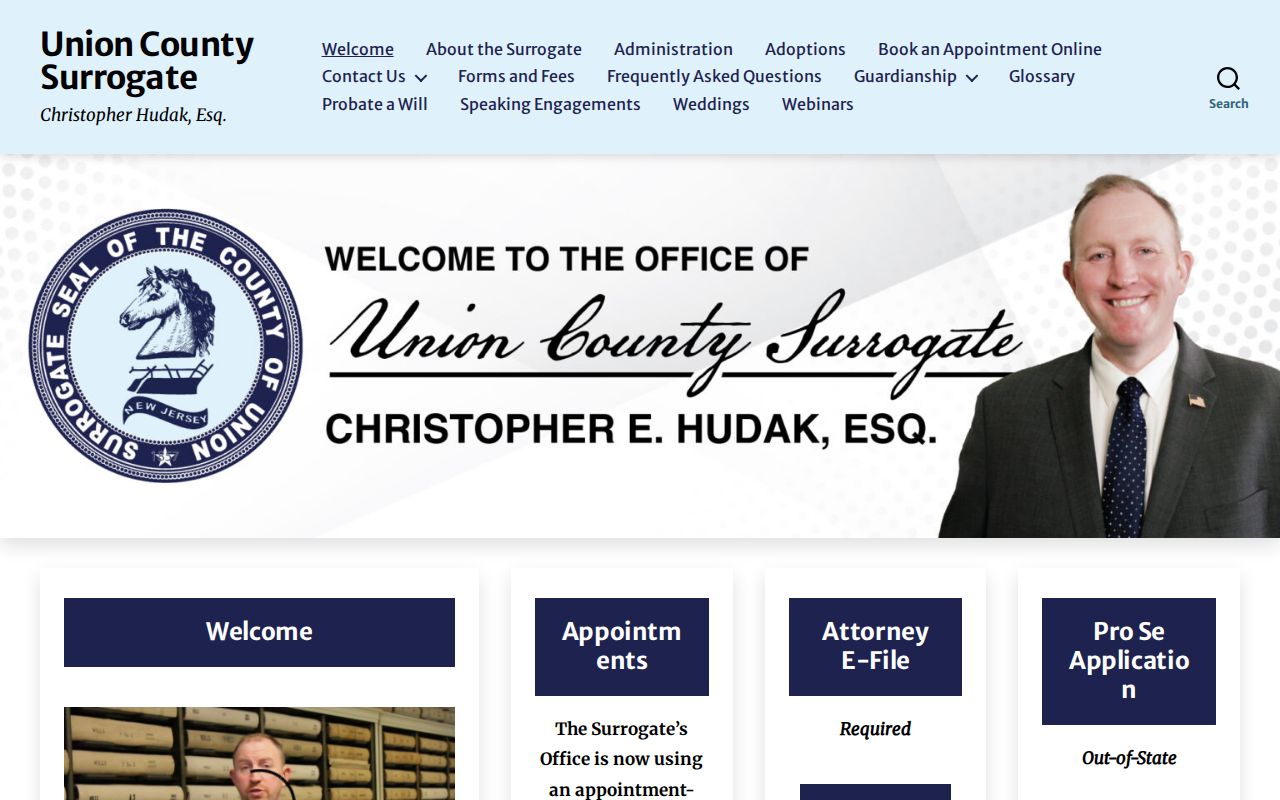
Use an estate date, deed reference, and the file's own parties to decide whether probate belongs in the address chronology.
Newspaper and obituary material can supply an event date, relatives, a former address, or a community reference. It should be read beside a deed, certificate, or court record when a legal fact matters. The State Archives adds long-term vital, census, divorce, naturalization, military, county, and microfilm holdings, while access to vital records remains subject to New Jersey's current eligibility and genealogy rules.
Cranford Previous Residents and Lawful Use
The strongest address history keeps each record in its lane. Property Explorer establishes the modern parcel key. UCPA and the Record Room establish recorded land events. Directories and censuses supply dated household leads. Sanborn maps supply building evidence. Newspapers and probate may explain a transition. A comparison table or research log should retain the source date, quoted name, address form, block and lot, and page or instrument reference. That structure makes it easier to spot a conflict instead of smoothing one over.
Lawful use. Use prior-resident research for family history, house history, estate questions, civic curiosity, and other lawful personal purposes. Do not use records or search results to harass, stalk, or harm any living person.
Municipal records not posted online may be requested under the New Jersey Open Public Records Act (OPRA), N.J.S.A. 47:1A-1 et seq., subject to exemptions and protected information. OPRA does not override sealed material, restricted personal data, address-confidentiality protections, or Daniel’s Law redactions. A missing address can be a legal protection rather than an error.